


Background
The Dutch ME/CFS Cohort and Biobank Consortium (NMCB) is a national collaboration of research institutes, patient organisations and clinical centres dedicated to biomedical research into ME/CFS and post-acute infection syndromes (PAIS), including post-COVID, persistent symptoms following Lyme disease, Q fever and post-sepsis.
One of our consortium’s activities is the establishment of a large patient cohort and biobank. The biobank collects medical data and biological samples from patients for scientific research, while the cohort serves as a patient registry to facilitate clinical studies.
Particular attention is paid to including severely ill patients and applying international diagnostic standards, such as the Canadian Consensus Criteria (CCC), the International Consensus Criteria (ICC) and the Institute of Medicine (IOM) criteria.
Strong emphasis is placed on national and international collaboration, as well as the harmonisation of methods and the exchange of data. Experience has shown that this type of collaboration can lead more quickly to reliable results and the implementation of new treatments. To support this, the consortium follows the FAIR principles, making data reusable by researchers worldwide and opening up opportunities for new research approaches.
Building on this infrastructure and working closely with patient organisations, researchers within the consortium conduct studies aimed at gaining a better understanding of the underlying disease mechanisms. The focus is on developing new approaches to treatment and diagnosis.
Which samples are available?
Sample | Type |
|---|---|
Serum | |
Serum
Plasma | EDTA, Heparin, Citrate |
PAXgene | For RNA isolation |
DNA | isolated |
PBMCs | Ficoll, CPT, SepMate |
Urine | |
Saliva | |
Feces |
Which data are available?
Clinical laboratory measurements
Blood tests | Parameters | |
|---|---|---|
Haematology | Haemoglobin, haematocrit, white cell differential | |
Glucose regulation | HbA1c | |
Renal function | Creatinine, estimated glomerular filtration rate (eGFR) | |
Inflammation | C-reactive proteïn (CRP) | |
Iron status and vitamins | Ferritin, vitamine B12 | |
Thyroid function | TSH / T4 | |
Muscle enzyme | Creatin kinase (CK) | |
Liver enzymes | Alanine aminotransferase (ALT), gamma-GT (GGT) | |
Elektrolytes and minerals | Sodium, potassium, calcium, phosphate | |
Protein status | Albumin | |
Urine dipstick | Protein, blood, glucose, leukocyten |
Physical measurements
- NASA Lean Test
- Cardiovascular measurements (ECG (elektrocardiogram), ICG (Impedance cardiogram), BP (blood pressure), oximetry)
- Handgrip strength
- Antropometric measurements
- Beighton-scale
- MRI
Surveys
NMCB questionnaires (PROMs)
Symptoms and daily functioning
Questionnaire | What it measures |
|---|---|
DSQ-SF / DSQ-2 | ME/CFS symptom screening |
COMPASS-31 | Dysautonomic symptoms |
RAND-36 | Health-related quality of life |
Bell Disability Scale / Karnofsky Performance Scale | Physical functioning |
Good Day / Bad Day (including HUA) | Daily function and upright time |
CIS | Fatigue and related limitations |
FSS | Impact van vermoeidheid |
BPI- short form | Pain severity and impact |
Pain-DETECT* | Neuropathic pain features |
Sleep, mood, lifestyle and gut health
Questionnaire | What it measures |
|---|---|
PSQI | Sleep quality |
ESS | Daytime sleepiness |
PHQ-2 | Depression screening |
CAGE-AID | Alcohol and drug problems |
Bristol stool chart | Stool form and consistency |
DFI-FFQ | Dietary fibre intake |
GSRS | Gastro-intestinal symptoms |
Rome IV-vragenlijsten | Functional GI disorders |
Health, family history & lifestyle survey: health history, co-morbidities,
medication, and lifestyle
Primary physician records
Linkage to national bureau of statics database:
health care use and insurance data, mortality data, work, income and demographics, national screenings data (e.g., covid vaccination and screening)
Amsterdam Cognition Scan (ACS)
Seven cognitive tests and what they measure:
Test | What it measures |
|---|---|
Connect the dots I & II | I: Visual tracking and processing speed. II: Mental flexibility and divided attention. |
Wordlist – Learning, Delayed Recall & Recognition | Learning new verbal information, then recallingand recognising it after a delay. |
Reaction speed | How quickly someone responds to a visual signal. |
Place the beads | Planning ahead and controlling impulsive responses. |
Box tapping | Short-term memory for locations and spatial sequences. |
Fill the grid | Fine motor speed and control. |
Digitale sequences I&II | I: Attention and immediate recall of digits. II: Working memory, holding and reordering information. |
Source:official ACS test battery; Feenstra et al. (2018), Multimedia Appendix 1
Request for samples and data
Governance
Within this infrastructure, researchers both within and outside our consortium can request samples and data for research purposes.
In consultation with patient organisations, a Memorandum of Understanding (MoU) has been developed to provide the overarching governance framework for access to and use of data and biological materials from the Netherlands ME/CFS Cohort & Biobank (NMCB) consortium. It brings together three sources under a single, unified policy: the adult cohort (Amsterdam UMC), the paediatric cohort (UMC Utrecht) and the brain tissue biobank (NIN-KNAW).
The aim is twofold: to facilitate high-quality biomedical research into ME/CFS and PAIS, and to protect the interests and integrity of participants.
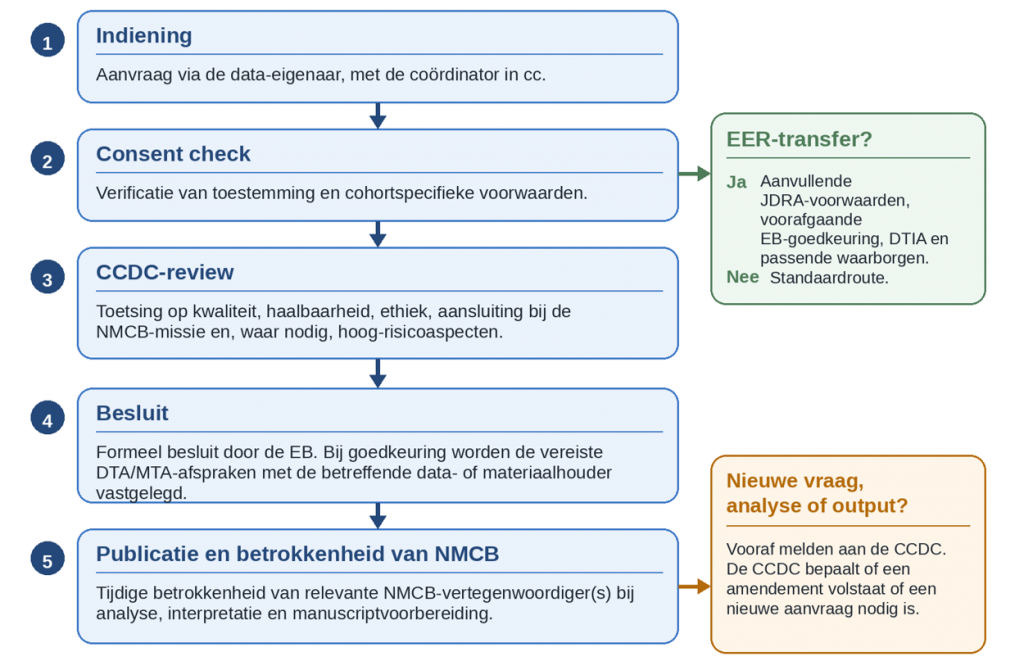
All external sample and data requests (i.e. requests from researchers not affiliated with the NMCB consortium) are first reviewed by the Consortium Cohort and Data Committee (CCDC). The CCDC is an autonomous review body that assesses scientific feasibility, alignment with the NMCB mission, participant consent and potential risks. The CCDC issues a recommendation that carries significant weight. The Executive Board (EB) makes the final decision and may deviate from the recommendation only with a reasoned justification. Additional safeguards apply to high-risk requests that could lead to potentially stigmatising interpretations.
The MoU is available in Dutch and English
Aanvraagprocedure
De aanvraagprocedure vindt plaats volgens de volgende flowchart:
Sample/Data release
Once approved by the CCDC/EB, the request will be processed.
Data
The NMCB data management team will begin processing the request. Depending on the current workload, we aim to deliver the data within two weeks.
Samples
In this case, the data management team will prepare a sample release list for the biobank. Depending on the specific requirements (for example, the need for matched controls), this may take a little longer. The biobank also has its own processing time, depending on its workload. We therefore recommend allowing at least three weeks for the entire process.
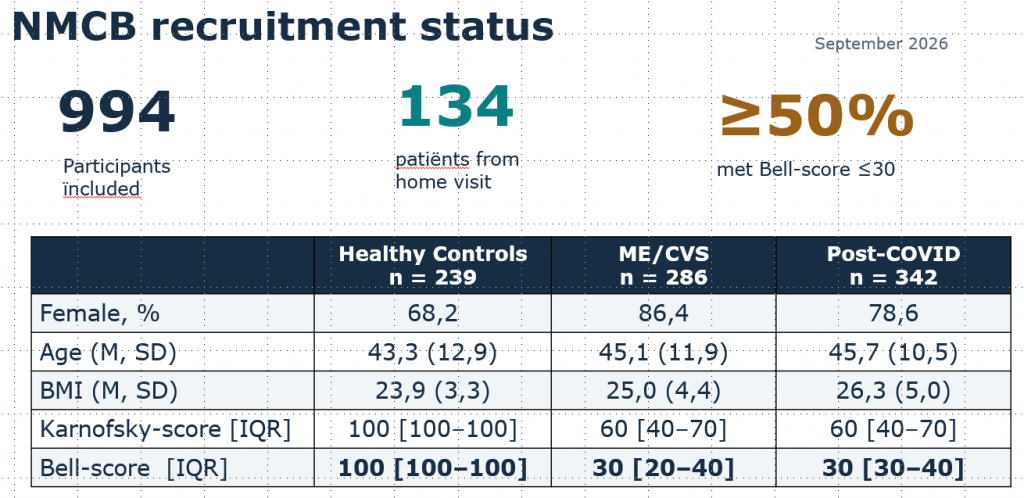
Current status of recruitment (we try to update monthly):