



Background
The Dutch ME/CFS Cohort and Biobank Consortium (NMCB) is a national collaboration of research institutes, patient organisations and clinical centres dedicated to biomedical research into ME/CFS.
One of our consortium’s activities is the establishment of a large patient cohort and biobank. Particular attention is paid to including severely ill patients and applying international diagnostic standards. The biobank collects medical data and biological samples from patients for scientific research, while the cohort serves as a patient registry to facilitate clinical studies.
Building on this infrastructure and working closely with patient organisations, researchers within the consortium will conduct studies aimed at gaining a better understanding of the underlying mechanisms involved in the development of ME/CFS. The emphasis will be on developing new approaches to treatment and diagnosis.
The aim of this project is to establish a national infrastructure for biomedical research into ME/CFS, enabling universities, academic medical centres and other research centres to collaborate as broadly as possible. Establishing a national patient cohort and biobank is an essential part of this effort. Strong emphasis is placed on national and international collaboration, as well as the harmonisation of methods and the exchange of data.
The consortium thus provides a national infrastructure for scientific collaboration, collecting high-quality patient data and making it available for multidisciplinary biomedical research.
This research is carried out in collaboration with ME/CFS biobanks and researchers in the United Kingdom, Germany, the United States, Canada and Australia. There is also national collaboration, including with ME/CFS Lines, the other consortium awarded funding under the programme.
These collaborations focus on data harmonisation and the national and international exchange of data. Experience has shown that this type of collaboration can lead more quickly to reliable results and the implementation of new treatments. To support this, the consortium follows the FAIR principles, making data accessible and reusable by other researchers worldwide and opening up many new research opportunities.
The NMCB consortium will also bridge the gap between ME/CFS research and research into syndromes with similar symptoms and impacts, such as long COVID, Lyme disease and the long-term effects of Q fever. This will be achieved, in part, through collaboration with existing cohorts and biobanks, for example those involving people with long COVID and Lyme disease. These patient groups will also be studied within the NMCB consortium.
Which samples are available?
- Serum
- Plasma (EDTA, Heparine, Citraat)
- PAXgene
- DNA
- PBMCs (Ficoll, CPT, SepMate)
- Urine
- Saliva
- Feces
Which data are available?
Physical measurements
- NASA Lean Test
- Cardiovasculair measurements
- handgrip strength
- Antropometric meeasurements
- ECG (electrocardiogram)
- Beighton-scale
- MRI
Surveys
- Medical history and medication use
- Demografic data (amongst which ethnicity)
- RAND-36
- Pittsburgh Sleep Quality Index (PSQI)
- Epworth Sleepiness Scale (ESS)
- Checklist Individual grip strength (CIS)
- Brief Pain Inventory (BPI),possibly followed up with the painDETECT-questionnaire
- Amsterdam Cognition Scan
- Bell Disability Scale
- Fatigue Severity Scale (FSS)
- General medical history, family history of medical conditions and lifestyle
- Patient Health Questionnaire (PHQ)
- Composite Autonomic Symptom Score (COMPASS-31)
- Bristol Stool Scale
- Dutch Food Frequency Questionnaire (DFI-FFQ)
- Gastrointestinal Symptom Rating Scale (GSRS)
- Rome IV-criteria
- Good Day / Bad Day Questionnaire
Request for samples and data
Governance
Within this infrastructure, researchers both within and outside our consortium can request samples and data for research purposes.
In consultation with patient organisations, a Memorandum of Understanding (MoU) has been developed to provide the overarching governance framework for access to and use of data and biological materials from the Netherlands ME/CFS Cohort & Biobank (NMCB) consortium. It brings together three sources under a single, unified policy: the adult cohort (Amsterdam UMC), the paediatric cohort (UMC Utrecht) and the brain tissue biobank (NIN-KNAW).
The aim is twofold: to facilitate high-quality biomedical research into ME/CFS and PAIS, and to protect the interests and integrity of participants.
All external sample and data requests (i.e. requests from researchers not affiliated with the NMCB consortium) are first reviewed by the Consortium Cohort and Data Committee (CCDC). The CCDC is an autonomous review body that assesses scientific feasibility, alignment with the NMCB mission, participant consent and potential risks. The CCDC issues a recommendation that carries significant weight. The Executive Board (EB) makes the final decision and may deviate from the recommendation only with a reasoned justification. Additional safeguards apply to high-risk requests that could lead to potentially stigmatising interpretations.
The MoU is available in Dutch and English
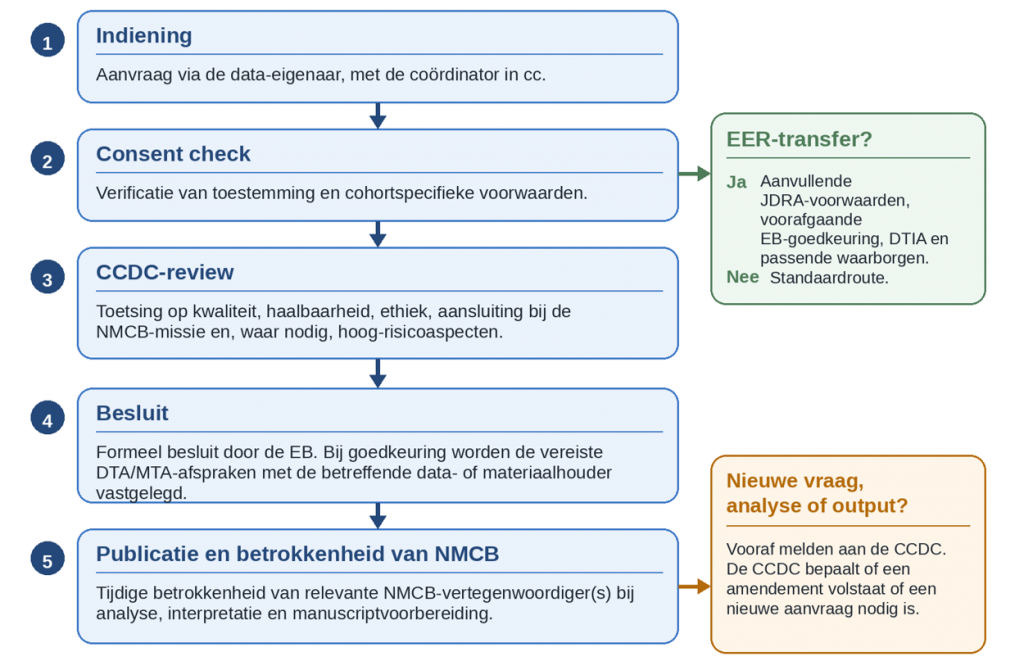
Aanvraagprocedure
De aanvraagprocedure vindt plaats volgens de volgende flowchart:
Sample/Data release
Once approved by the CCDC/EB, the request will be processed.
Data
The NMCB data management team will begin processing the request. Depending on the current workload, we aim to deliver the data within two weeks.
Samples
In this case, the data management team will prepare a sample release list for the biobank. Depending on the specific requirements (for example, the need for matched controls), this may take a little longer. The biobank also has its own processing time, depending on its workload. We therefore recommend allowing at least three weeks for the entire process.